???jsp.display-item.heading1???
Globalization, logics of action international labor standards and national goverment roles
| DC Field | Value | Language |
|---|---|---|
| dc.contributor.author | Sarosh Kuruvilla | - |
| dc.contributor.author | Anil Verma | - |
| dc.date.issued | 2004-06-30 | - |
| dc.identifier.issn | 1598-270X | - |
| dc.type | Article | - |
| dc.type.local | Article(Series) | - |
| dc.subject.keyword | international labor standards | - |
| dc.subject.keyword | logics of action | - |
| dc.subject.keyword | industrial relations | - |
| dc.subject.keyword | soft law | - |
| dc.subject.keyword | codes of conduct | - |
| dc.subject.keyword | ILO | - |
| dc.subject.keyword | WTO | - |
| dc.subject.keyword | certification | - |
| dc.subject.keyword | reporting | - |
| dc.subject.keyword | core labor | - |
| dc.subject.keyword | standards | - |
| dc.subject.keyword | labor standards and trade | - |
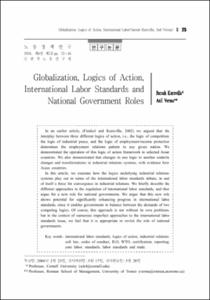
| dc.description.abstract | In an earlier article, (Frenkel and Kuruvilla, 2002) we argued that the interplay between three different logics of action, i.e., the logic of competition, the logic of industrial peace, and the logic of employment-income protection determines the employment relations pattern in any given nation. We demonstrated the operation of this logic of action framework in selected Asian countries. We also demonstrated that changes in one logic to another underlie changes and transformations in industrial relations systems, with evidence form Asian countries.In this article, we examine how the logics underlying industrial relations systems play out in terms of the international labor standards debate, in and of itself a force for convergence in industrial relations. We briefly describe the different approaches to the regulation of international labor standards, and then argue for a new role for national governments. We argue that this new role shows potential for significantly enhancing progress in international labor standards, since it enables governments to balance between the demands of two competing logics. Of course, this approach is not without its own problems, but in the context of numerous imperfect approaches to the international labor standards issue, we feel that it is appropriate to revisit the role of national governments. | - |
| dc.description.eprintVersion | published | - |
| dc.publisher | 한국노동연구원 | - |
| dc.publisher.location | eng | - |
| dc.identifier.uri | https://repository.kli.re.kr/handle/2021.oak/2310 | - |
| dc.language | kor | - |
| dc.format.extent | 20 | - |
| dc.rights.accessRights | Free access | - |
| dc.rights.rightsHolder | 한국노동연구원 | - |
| dc.rights.license | CCL_BY_NC_ND | - |
| dc.rights.license | KOGL_BY_NC_ND | - |
| dc.citation.title | 노동정책연구 | - |
| dc.citation.volume | 제4권 | - |
| dc.citation.number | 제2호 | - |
| dc.citation.date | 2004 | - |
| dc.citation.startPage | 25 | - |
| dc.citation.endPage | 44 | - |
- Files in This Item:
-
-
Download
 노동정책연구_제4권_제2호_2.pdf
기타 데이터 / 385.51 kB / Adobe PDF
노동정책연구_제4권_제2호_2.pdf
기타 데이터 / 385.51 kB / Adobe PDF
-


Items in Repository are protected by copyright, with all rights reserved, unless otherwise indicated.