???jsp.display-item.heading1???
Poverty, altruism, and economic growth
| DC Field | Value | Language |
|---|---|---|
| dc.contributor.author | Injae Lee | - |
| dc.date.issued | 2006-09-30 | - |
| dc.identifier.issn | 1598-270X | - |
| dc.type | Article | - |
| dc.type.local | Article(Series) | - |
| dc.subject.keyword | overlapping generation model | - |
| dc.subject.keyword | multiple equilibria | - |
| dc.subject.keyword | human capital investment | - |
| dc.subject.keyword | parental altruism | - |
| dc.subject.keyword | fertility | - |
| dc.subject.keyword | economic growth | - |
| dc.subject.keyword | poverty trap | - |
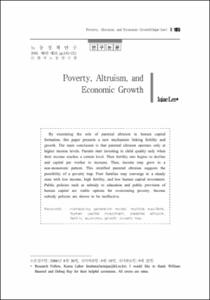
| dc.description.abstract | By examining the role of parental altruism in human capital formation, this paper presents a new mechanism linking fertility and growth. The main conclusion is that parental altruism operates only at higher income levels. Parents start investing in child quality only when their income reaches a certain level. Then fertility rate begins to decline and capital per worker to increase. Thus, income may grow in a non-monotonic pattern. This stratified parental altruism suggests the possibility of a poverty trap. Poor families may converge to a steady state with low income, high fertility, and low human capital investment. Public policies such as subsidy to education and public provision of human capital are viable options for overcoming poverty. Income subsidy policies are shown to be ineffective. | - |
| dc.description.eprintVersion | published | - |
| dc.publisher | 한국노동연구원 | - |
| dc.publisher.location | eng | - |
| dc.identifier.uri | https://repository.kli.re.kr/handle/2021.oak/2363 | - |
| dc.language | kor | - |
| dc.format.extent | 29 | - |
| dc.rights.accessRights | Free access | - |
| dc.rights.rightsHolder | 한국노동연구원 | - |
| dc.rights.license | CCL_BY_NC_ND | - |
| dc.rights.license | KOGL_BY_NC_ND | - |
| dc.citation.title | 노동정책연구 | - |
| dc.citation.volume | 제6권 | - |
| dc.citation.number | 제3호 | - |
| dc.citation.date | 2006 | - |
| dc.citation.startPage | 185 | - |
| dc.citation.endPage | 213 | - |
- Files in This Item:
-
-
Download
 노동정책연구_제6권_제3호_7.pdf
기타 데이터 / 420.31 kB / Adobe PDF
노동정책연구_제6권_제3호_7.pdf
기타 데이터 / 420.31 kB / Adobe PDF
-


Items in Repository are protected by copyright, with all rights reserved, unless otherwise indicated.